Why Hours Alone Is the Wrong Metric for Language Fluency

There's a number that almost every language learner tracks obsessively: hours studied. It shows up in Reddit posts ("500 hours in, still can't understand native speakers"), in app dashboards, in the folklore around how long it takes to reach fluency. It feels like the right thing to measure because the amount of time you spend with your language can't be faked.
But hours measure your commitment to studying, not your progress toward fluency. And optimizing for the wrong metric doesn't just fail to help you, it actively misleads you about where you stand.
Hours Are an Input Metric
Think about two learners, both logging 10 hours this week. The first spent those hours doing passive vocabulary list review, cycling through a deck, recognizing words they already half-know. The second spent 10 hours in deliberate comprehensible input: listening to and reading material just above their current level, pushing their comprehension forward with each session.
The hour is identical. The progress is not.
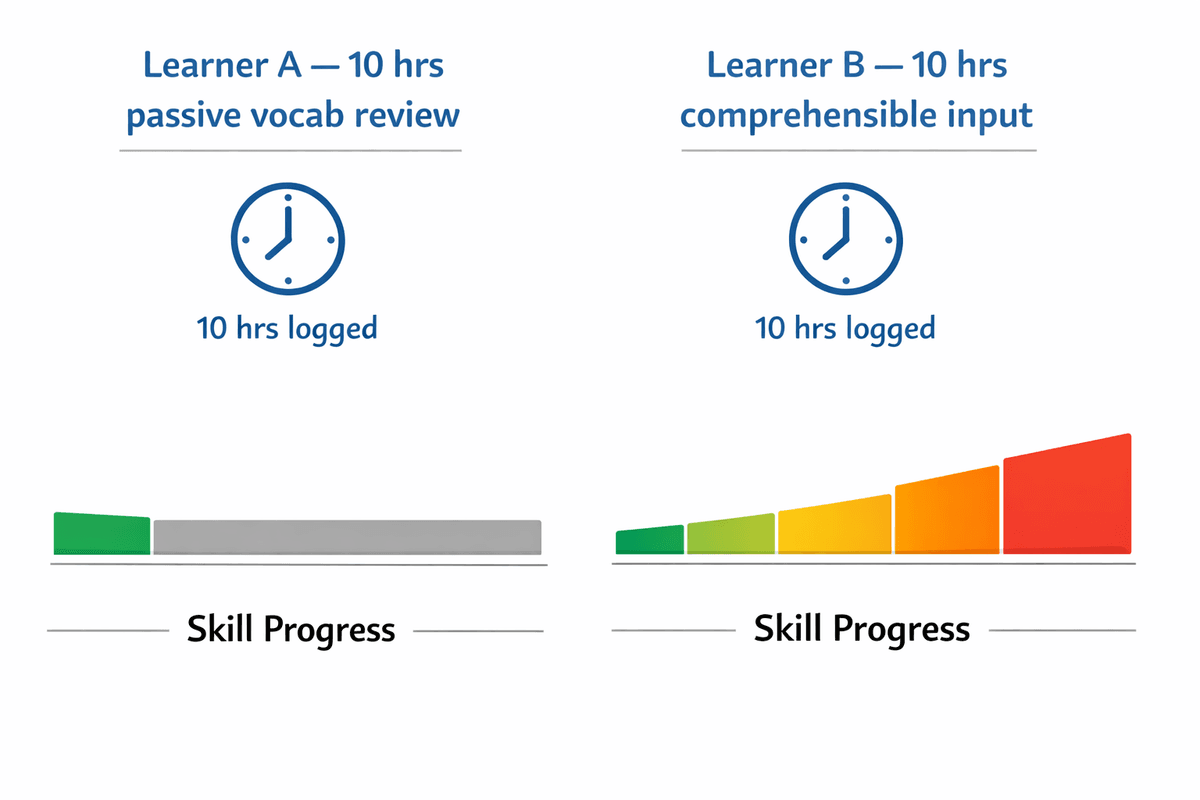
Any metric that treats these two learners the same is failing at its core job. Hours tell you how long you sat with the language. They say nothing about whether anything happened as a result.
Optimizing for Hours Warps Your Behavior
Here's what makes this worse: the metric doesn't just fail to capture progress, but it actively shapes what you do in ways that undermine it.
When your primary signal is hitting a daily hour target, you unconsciously migrate toward comfortable activities. Reviewing Anki cards you mostly know. Having a podcast play in the background while multitasking, too distracted to actually be listening. Re-reading a passage you've already understood. Watching a show with subtitles when you could go without. These things feel productive. They don't create the low-grade discomfort that real acquisition requires.
What gets avoided? The harder work. Real conversation with native speakers, where you're slow and you stumble. Wrestling with native or advanced listening content where you need to be hyperfocused, use context clues, and hold the ambiguity. These activities are demoralizing in the short term but high-leverage in the long term. An hours-based feedback loop systematically pushes you away from them.
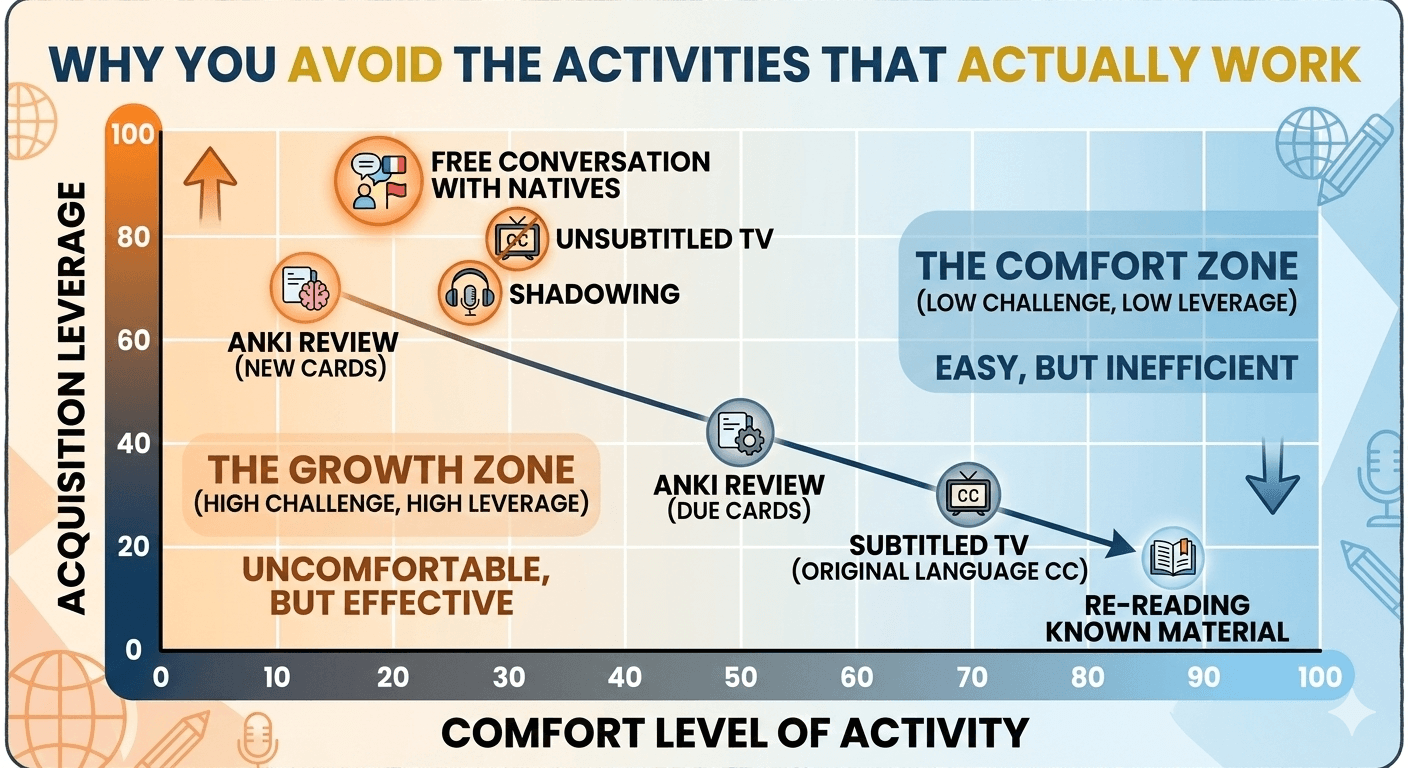
The metric shapes the behavior. The behavior stops serving the goal.
Fluency Has Structure That Hours Ignore
Fluency isn't a single thing you accumulate in a linear way. It's an interplay of distinct competencies (listening comprehension, vocabulary depth, reading speed, speaking automaticity, writing precision) that develop at different rates depending on how you study.
Someone with 500 hours of Anki and someone with 500 hours of comprehensible input are not at "500 hours of Spanish." They are in completely different places with completely different skill profiles. The Anki learner might have strong word recognition and weak listening comprehension. The comprehensible input learner might understand a lot but struggle to produce output under pressure. Neither is simply "ahead" of the other, but they've developed different things.
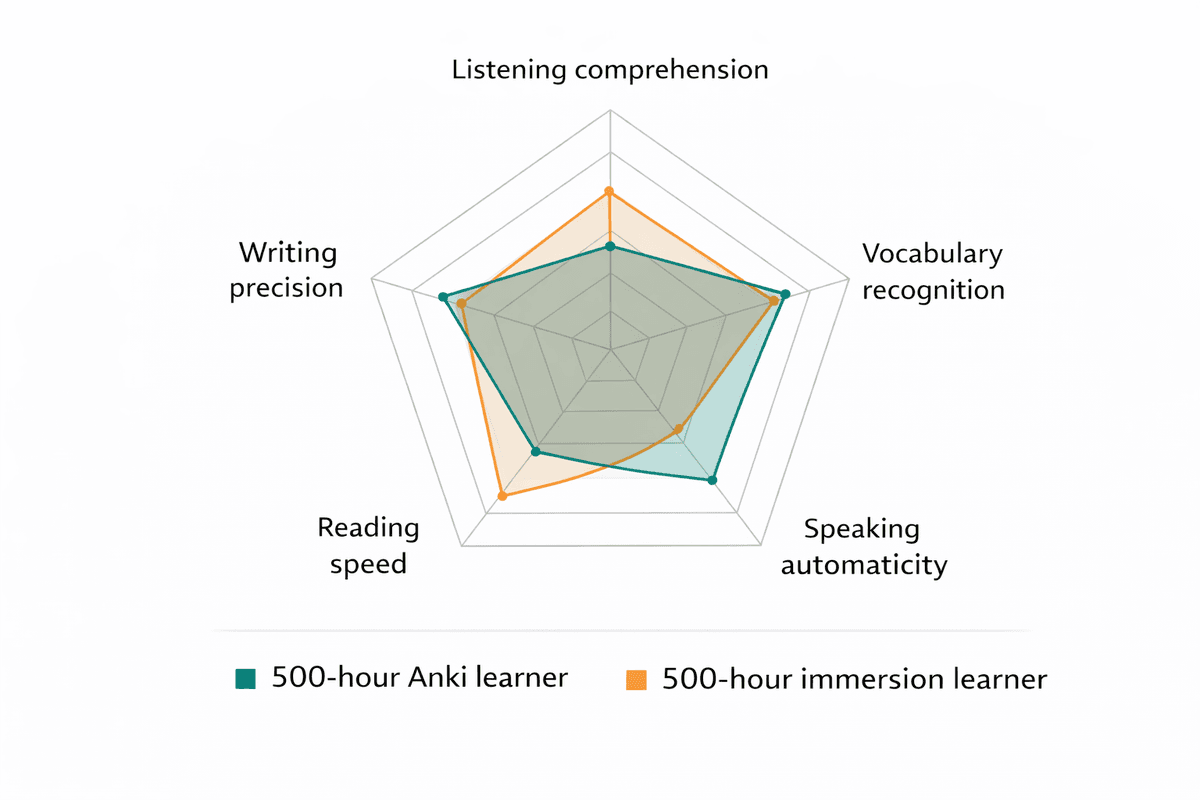
CEFR levels acknowledge this. B2 listening and B2 speaking are not the same achievement, and reaching one doesn't imply the other. Research on skill acquisition is clear that comprehension and production are partially distinct, that vocabulary breadth and depth diverge, that reading fluency and spoken fluency follow different developmental curves.
Hours erase all of this. Five hundred hours is not a location. It's not even a useful approximation of one.
The Right Metric Is Skill-Specific Progress
What you actually want to know isn't how long you studied. It's whether studying is working.
Is your listening comprehension moving? Can you follow content this month that felt difficult to follow a few months ago? Are you encountering known words in new contexts, which signals vocabulary consolidating rather than just being recognized in isolation? Are you speaking with less hesitation than six weeks ago, or are you still hitting the same walls? Is your reading speed increasing, or are you still translating word by word in your head?
Key Takeaway
The metrics that matter are skill-specific: listening comprehension, vocabulary depth, speaking automaticity, and reading speed. These are harder to measure than hours, but they're the only signals that tell you whether studying is actually working, and what to adjust if it isn't.
These are the signals that matter. They're harder to measure than hours, but not impossible, and the difficulty is what makes them worth measuring. A metric that's hard to fake is a metric that tells you something real.
When you track at this level, you also know what to do next. If your listening comprehension is lagging behind your reading, that's a signal to shift your input medium. If your speaking automaticity isn't developing, that's a signal that comprehension-only methods aren't enough and you need more output practice. The data points toward action.
This Is What LanguaTracker Is Built Around
The answer isn't to stop logging time, but it's to treat that log as one input among several, not the final word on your progress.
Logging your study activity matters. Without it, you have no data to work with. But most tracking tools stop there, surfacing an hour total and leaving you to draw your own conclusions. LanguaTracker starts from the same place but treats that log as a source of richer signals rather than the signal itself.
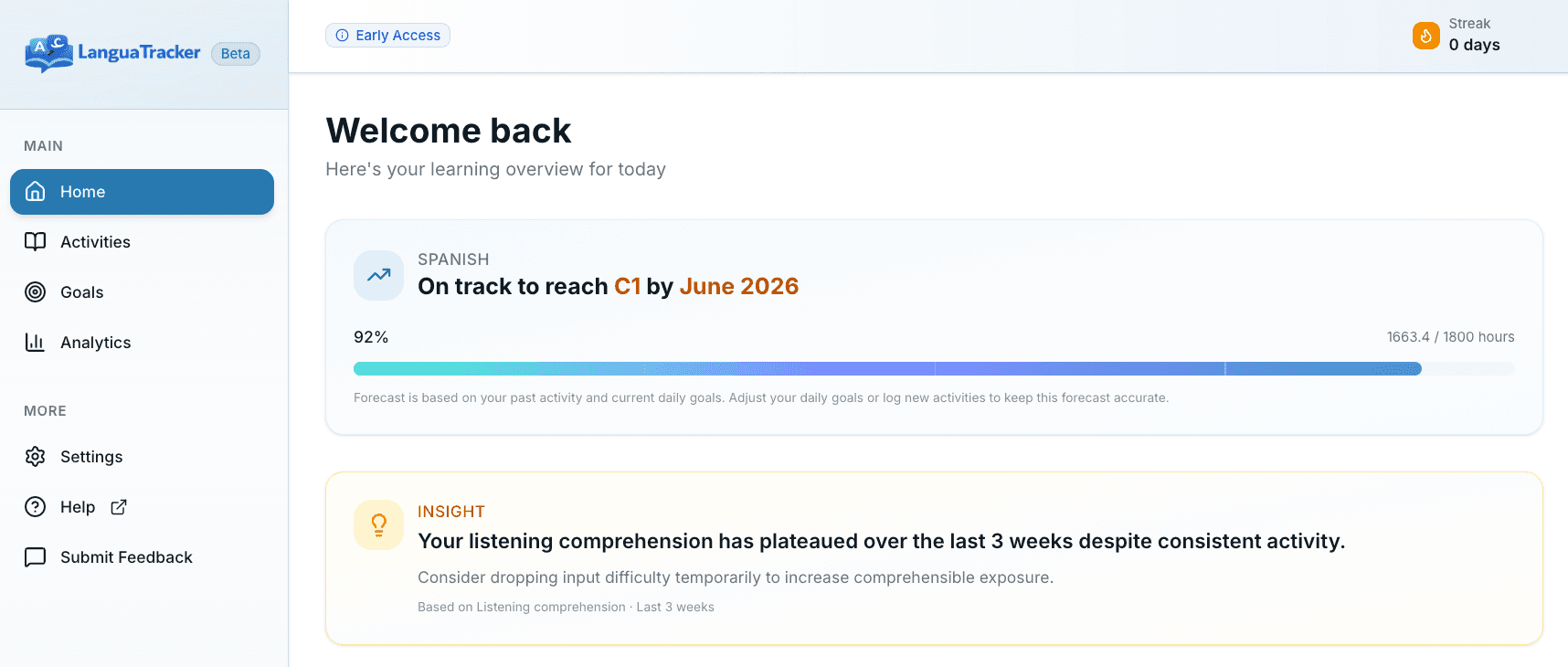
It organizes all your study activity by category so your time is attributed to the skills it actually develops rather than pooled into an undifferentiated total. As you study, it tracks the words, phrases, and concepts you're encountering and learning, building a picture of your vocabulary coverage over time. And after sessions, it captures your reported comprehension levels, turning a subjective feeling ("I kind of understood that podcast") into a data point you can monitor and track.
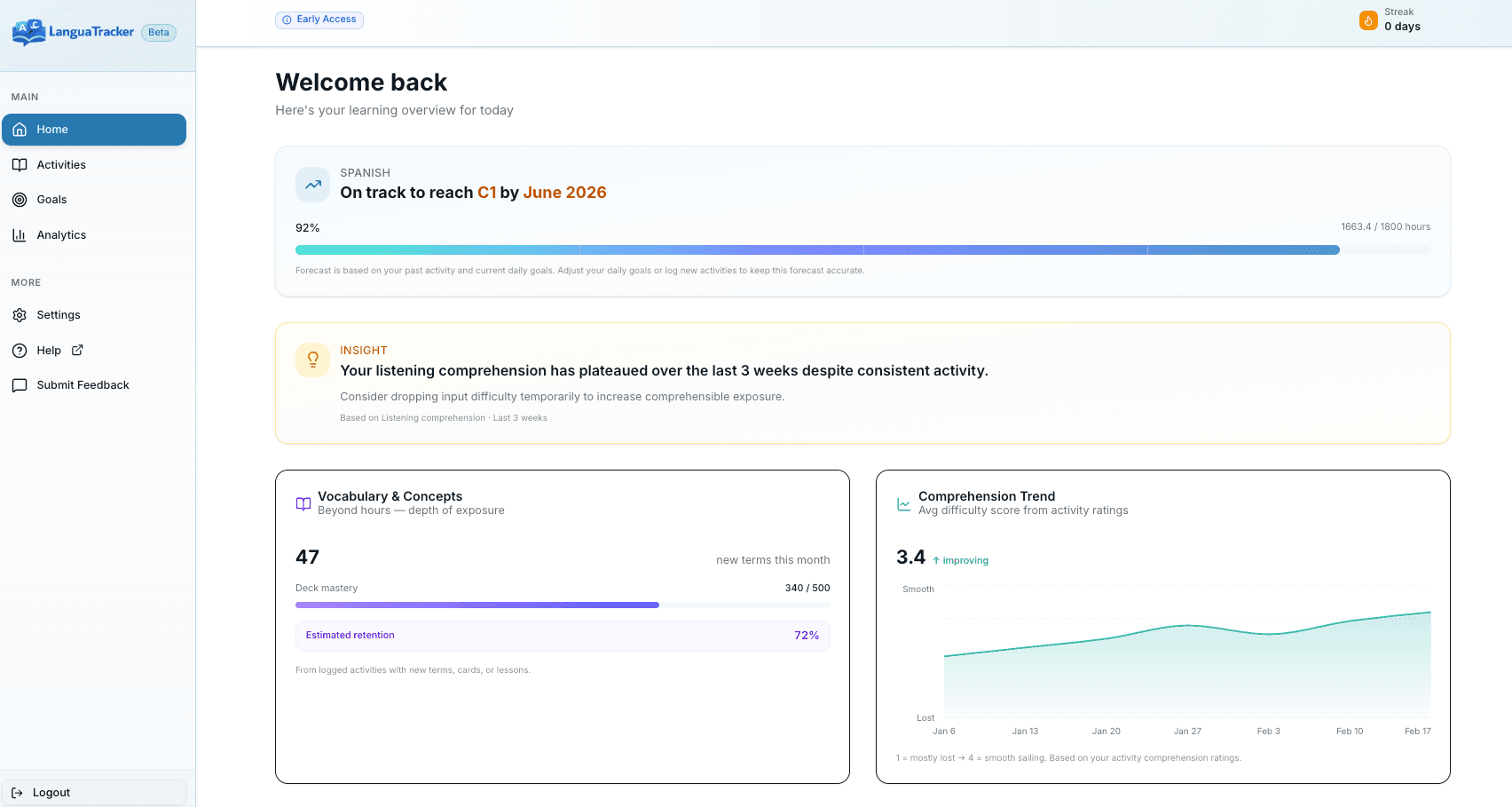
The result is that LanguaTracker can generate fluency forecasts and surface actual insights: your comprehension in listening is improving faster than in reading, which might mean your current input mix is skewed; your vocabulary encounters are high but your reported comprehension isn't tracking with them, which might mean you're hitting material that's too difficult. These are the kinds of signals that tell you whether your study time is working and what to adjust if it isn't.
Hour tracking is the language learning equivalent of measuring how long you spent at the gym rather than whether you're getting stronger. Time is a proxy for effort, and effort is a proxy for progress. Serious athletes still log their sessions, but they measure lifts, times, and distances. They track the thing that changed.
Your language skills are the thing that changed, or didn't. That's what deserves to be measured.
Track What Actually Matters
Stop counting hours and start measuring progress. LanguaTracker organizes your study activity by skill, tracks vocabulary coverage, and surfaces insights about whether your methods are working.
Start Tracking Today