Introducing LanguaTracker
You've maintained your Duolingo streak for 287 days straight. You've watched 43 YouTube videos in Spanish. You finished two novels in French and listen to German podcasts during your commute.
But here's the question that keeps every serious language learner up at night: Am I actually getting better?
Your progress is scattered across a dozen apps, browser histories, and dog-eared books. Duolingo celebrates your streak. YouTube recommends another video. But nobody shows you the complete picture of your language learning practice.
The Three-App Juggling Act
I built LanguaTracker after a year of learning Spanish the "organized" way.
I had a system: spreadsheets for my textbook progress, the Dreaming Spanish time tracker for comprehensible input hours, and Toggl Track for everything else. On paper, it was comprehensive. In practice, it was chaos.
Every time I finished a podcast episode, I'd open Toggl. After a Dreaming Spanish video, I'd log it in their tracker. Then I'd update my spreadsheet with weekly totals, manually copying numbers from two different apps, reformatting timestamps, calculating my own averages.
I was spending nearly as much mental effort tracking my Spanish learning as I was actually learning Spanish sometimes.
And I still couldn't answer simple questions like "How much time did I actually spend on reading Spanish books last month?" without opening three apps and doing mental math.
The breaking point came when I realized I'd stopped logging activities altogether. Not because I wasn't learning, I was still watching videos and reading every day but because the friction of tracking across three systems was killing my motivation.
Tracking my progress should be as easy as logging in to my favorite app.
Why Unified Tracking Changes Everything
Here's what research on language acquisition tells us: consistency beats intensity, and visibility drives consistency.
Studies on spaced repetition and distributed practice consistently show that regular, shorter study sessions lead to better long-term retention than cramming1. And research on goal-setting and self-monitoring demonstrates that tracking progress significantly increases adherence to learning goals2.
When you can see your learning patterns, not just from one app, but across your entire ecosystem, something powerful happens:
- You discover that your "bad weeks" still include 3+ hours of learning (just not where you expected)
- You identify which resources actually move the needle vs. which feel productive but aren't
- You spot gaps before they become problems (too much passive listening, not enough active speaking)
- You build genuine motivation from real progress that doesn't rely on external rewards
But tracking across resources is genuinely hard. Apps don't talk to each other. Books don't have APIs. Conversations with native speakers don't generate automatic logs. And the data you collect is scattered across multiple apps and devices.
The solution isn't magical automation, it's removing the friction from manual tracking. When logging takes 10 seconds instead of 10 minutes, when all your data lives in one place instead of three apps, consistency becomes achievable.
And that's where LanguaTracker comes in.
How LanguaTracker Works

LanguaTracker is built on one core principle: tracking should take 10 seconds, not 10 minutes.
Quick Capture, Deep Insights
Log any learning activity in under 10 seconds:
- "30 min Duolingo"
- "Coffee Hour with Maria - Spanish"
- "Chapter 4 of Le Petit Prince"
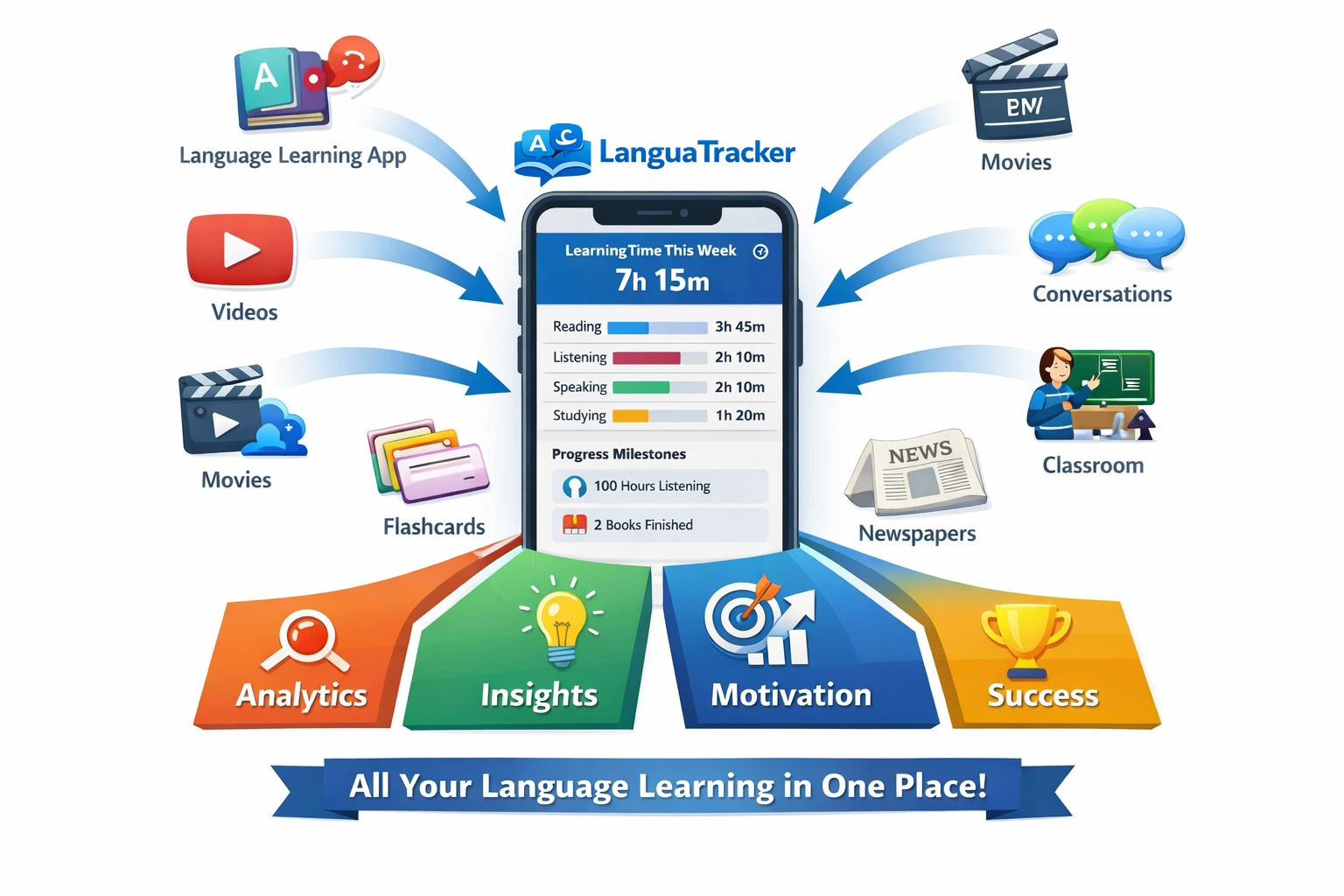
LanguaTracker automatically categorizes activities, tracks time, and builds your learning profile.
The Dashboard That Actually Tells You Something
Instead of vanity metrics, you get actionable insights:
- Resource Distribution: Discover you're spending 80% of your time on passive activities (listening/reading) and only 5% on active production (speaking/writing)
- Consistency Patterns: See your true weekly average (not just your best week or longest streak)
- Progress Milestones: Track concrete achievements like "100 hours of listening" or "10 conversations with native speakers"
- Goal Tracking: Set flexible goals that match real life—"5 hours per week" not "30 minutes every single day"
Works With Your Actual Learning Life
- Manual entry: For books, conversations, classes, and real-world practice
- Quick templates: Save frequently used activities (your regular podcast, weekly tutor session)
- Flexible categorization: Tag activities by skill (reading, writing, listening, speaking), difficulty, or custom labels
- Multi-language support: Track multiple languages simultaneously without confusion
What Makes LanguaTracker Different
It's not another app promising fluency. It's the support system serious language learners have been missing.
We're not competing with Duolingo or Anki or your textbook. We're the system that finally lets you see what's working across all of them.
Most tracking tools are either:
- Too generic (habit trackers that don't understand language learning)
- Too specific (built into one platform like Duolingo, ignoring everything else)
- Too complicated (require you to become a data analyst)
LanguaTracker sits in the sweet spot: purpose-built for language learning, resource-agnostic, and simple enough to use daily.
For the Long Haul
Language learning isn't a sprint. It's not even a marathon. It's more like training for your entire life, and you need a system that grows with you.
Whether you're grinding through beginner textbooks, consuming native content, or maintaining multiple languages simultaneously, LanguaTracker adapts to your practice.
Because the learners who succeed aren't the ones with the longest streak or the fanciest app subscription. They're the ones who show up consistently, learn from their patterns, and adjust their approach based on real data.
Start Measuring Your Path to Fluency
LanguaTracker is now available for early access. We're working with 100 language learners to refine the experience before our public launch.
Join the early access → Sign up here to get early access and help shape the product.
No credit card required. Just bring your commitment to reaching fluency.
P.S. Even if you don't sign up, here's one actionable tip: This week, simply write down every language learning activity you do and how long it takes. You'll be surprised by what you discover about your actual (not imagined) learning habits. That's the first step toward real progress.
Footnotes
-
Cepeda, N. J., et al. (2006). Distributed practice in verbal recall tasks: A review and quantitative synthesis. Psychological Bulletin, 132(3), 354-380. ↩
-
Harkin, B., et al. (2016). Does monitoring goal progress promote goal attainment? A meta-analysis of the experimental evidence. Psychological Bulletin, 142(2), 198-229. ↩