
What Real Language Learning Progress Looks Like (It's Not Linear)
On one day, you can understand an entire podcast episode in the language you're learning without subtitles. But the day after, you can barely follow a YouTube video. You were improving (you're sure of it), so why does it suddenly feel like you're sliding backwards?
Here's the answer, and it changes everything: you are not failing. You are experiencing what real progress actually looks like in language acquisition.
The core problem isn't your study habits, your memory, or your method. It's that most learners are measuring progress the wrong way: by how they feel, not by what the data shows. And feelings during a language learning plateau are almost always wrong.
The Myth of Linear Progress
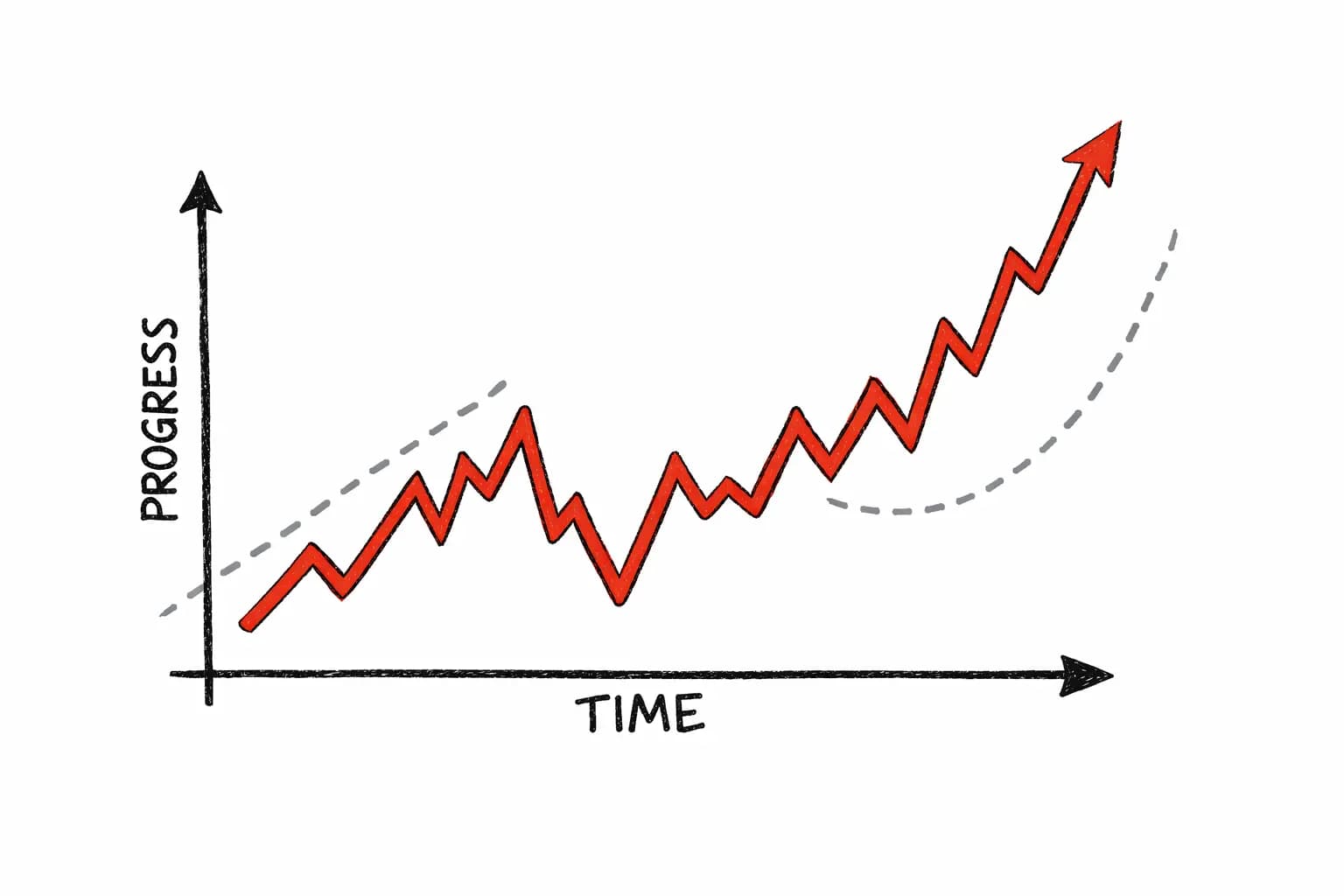
Most learners carry an unconscious assumption: effort in, results out. Study more, improve more. A straight line upward. That is not how language acquisition works. Real progress looks less like climbing a staircase and more like this:
Think of your target language as an image being revealed one pixel at a time. Every word, phrase, and grammar rule you learn reveals another pixel. Progress isn't always visible, sometimes hundreds of pixels fill in before the image suddenly snaps into focus. That's not stagnation. That's how the picture gets built. You don't need the full picture to recognize what it is, and you don't need every word to understand what someone means.
The gap between what learners expect and what they actually experience is where frustration lives. It is also where most people quit.
Three Reasons Progress Feels Like Regression
Understanding why progress feels inconsistent is the first step to stopping it from derailing you.
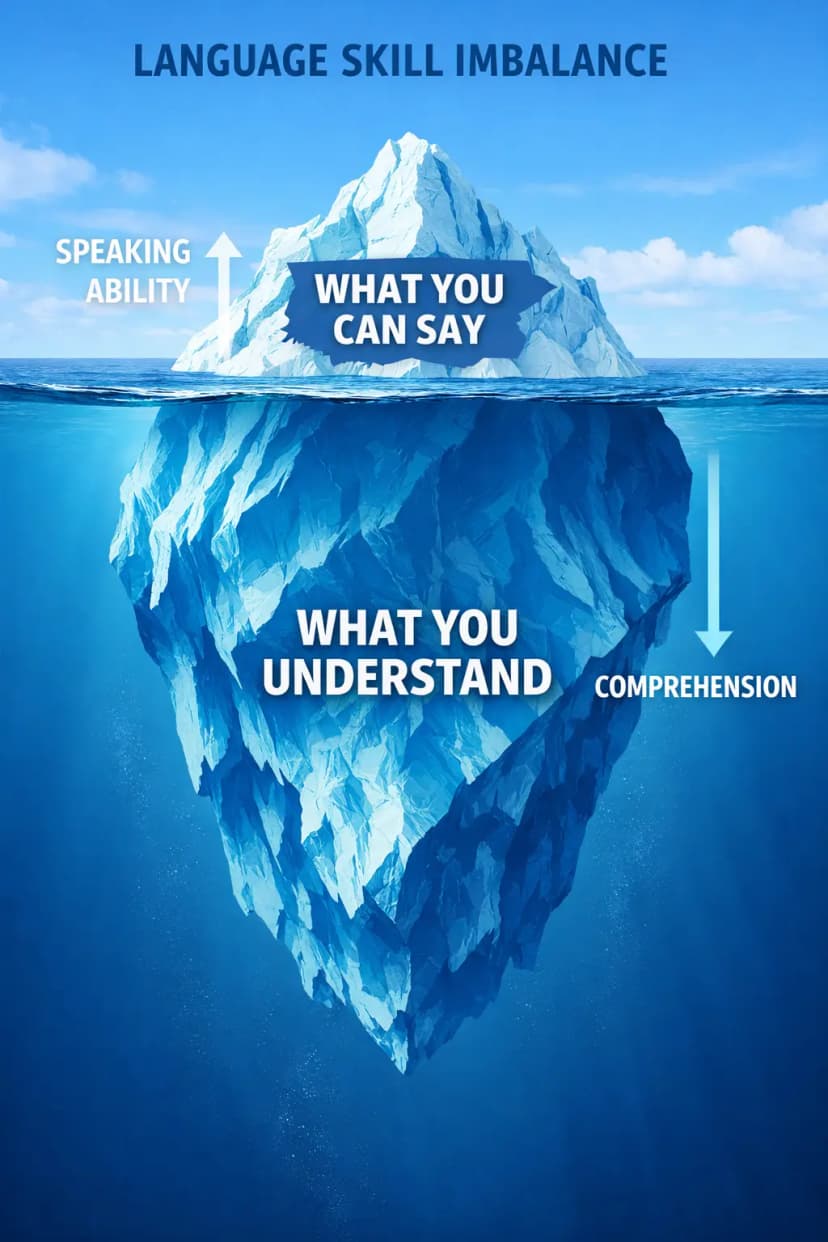
1. Comprehension improves before output catches up. Your brain stores and processes new language much faster than it can retrieve it for active use. Research on distributed practice (Cepeda et al., 2006) shows that learning deepens through repeated spaced exposure, even when there are no visible gains in the short term. Struggling to form sentences despite understanding more isn't stagnation. It's the natural lag before speaking catches up to listening.
2. Your four skills grow at different rates. Listening, reading, speaking, and writing develop unevenly. Most learners consume far more than they produce, which means their comprehension can race ahead of their speaking confidence. That imbalance can feel like a regression, but it's simply a sign that output needs more deliberate, separate practice.
3. Awareness grows faster than ability. Early in learning, you don't know what you don't know, and that not knowing often masquerades as confidence. As you actually improve, you begin noticing your grammar gaps, your accent errors, the words you're reaching for and missing. This increased awareness makes you feel like you're getting worse. In reality, it's proof you've gotten better. You've reached the stage where you can finally see the distance left to travel, and that is one of the most significant milestones in language learning.
Why Data Beats Feelings Every Time
A meta-analysis by Harkin et al. (2016) found that monitoring progress significantly increases goal attainment across learning domains. The key word is monitoring. Not hoping, not feeling, not guessing...
When learners track their activity over weeks and months, something important becomes visible: even when confidence is low, cumulative exposure keeps rising. That compounding exposure is what drives breakthroughs. But without tracking, a plateau feels permanent. With tracking, it looks temporary.
Consider the difference:
Without tracking, you tell yourself: "I've studied for six months and still can't hold a conversation."
With tracking, you see: "42 listening hours this month, up from 28 last month. Three speaking sessions this week versus one last week. Eighteen percent more total input than the month before."
The first version is emotion. The second is evidence. Emotion lies during plateaus. Data doesn't.
Key Takeaway
Language learning progress is cyclical and compounding, not linear. Plateaus and dips are not signs of failure. They are natural phases in which your brain reorganizes and consolidates information. The difference between learners who quit and those who succeed often comes down to understanding this pattern and having data to show that progress is still happening.
The Plateau Is Where Growth Actually Happens
This is counterintuitive, but it's one of the most important things to understand about language learning: the plateau is not where growth stops. It's where growth consolidates.
Research by Walker & Stickgold (2004, 2006) on memory consolidation suggests that learning is actively processed during rest and offline periods, meaning progress continues even when performance appears flat. Think of it like resistance training: your muscles don't grow during the workout. They grow during recovery. Language learning works the same way. The flat periods are when your brain processes everything you've been feeding it.
Learners who quit during plateaus assume they've hit their ceiling. Learners who push through almost always experience a sudden jump in comprehension or fluency weeks later. The difference between those two groups usually has nothing to do with talent or intelligence. It comes down to whether they understood that the invisible phase is a feature, not a bug.
Signs You're Improving (Even When It Doesn't Feel Like It)
Forget "fluency" as a metric because it's too vague and too distant to be useful on a daily basis. Instead, watch for these smaller, more reliable signals:
- Words that used to blur together now stand out clearly
- You can follow along even when you miss a word or two
- Your brain stops translating everything back to English (or your native language) before you understand it
- The delay between thought and speech is getting shorter
- You self-correct mid-sentence instead of freezing up
These won't make good milestones to post about online. But they are real, measurable indicators that your brain is rewiring itself, and they're worth paying attention to.
⚠️ The Intermediate Danger Zone
It's worth naming this stage directly, because it's where the majority of learners give up.
Beginners see fast gains because everything is new. Advanced learners experience steady refinement. But intermediate learners get trapped in the middle: the novelty has worn off, progress is subtle and hard to see, awareness of mistakes is at its peak, and fluency still feels frustratingly far away.
Without a way to make progress visible, this stage feels pointless. Hours of study, nothing to show for it. This is exactly where most people decide the method isn't working, or that they simply aren't cut out for it.
Neither conclusion is correct. The intermediate plateau is a consolidation phase, which is the most important phase in the entire process. Pushing through it is less about motivation and more about having enough visibility into your own progress to know that something is still happening beneath the surface.
Frequently Asked Questions
Before we wrap up, here are some common questions that come up often about language learning plateaus:
Is it normal to feel like you're getting worse at a language you've been studying?
Yes, and it's one of the most common experiences in language learning. What feels like regression is usually one of two things: your awareness of mistakes has grown faster than your ability to fix them, or your comprehension has jumped ahead while your speaking hasn't caught up yet. Neither is regression. Both are signs of progress.
How long do language learning plateaus typically last?
There's no universal timeline, but most intermediate plateaus last anywhere from a few weeks to a few months. The duration depends less on ability and more on input volume and consistency. Learners who maintain regular exposure during a plateau tend to break through faster, not because they're more talented, but because the neural consolidation process requires continued input to complete.
What's the difference between a plateau and actually stalling?
A plateau means progress is happening beneath the surface even though it isn't visible yet. Stalling means input has dropped off and consolidation has nothing to work with. The easiest way to tell the difference is to track your activity. If your hours are consistent but your confidence is low, you're plateauing. If your hours have quietly dropped, that's a different problem with a simpler fix.
Should I change my study method when I hit a plateau?
Usually not immediately. The instinct to switch methods during a plateau is understandable but often counterproductive, it resets your exposure to new material before consolidation has finished. A better first step is to audit your input versus output balance. Most plateaus at the intermediate level are caused by too much passive consumption and not enough active production, not by a flawed method.
Why do I understand so much more than I can actually say?
his is called the input-output gap, and it's completely normal. Receptive skills (listening and reading) develop faster than productive skills (speaking and writing) because comprehension requires pattern recognition, while production requires real-time retrieval under pressure. The gap closes with deliberate speaking and writing practice. It won't close on its own through more listening alone.
Making Progress Visible
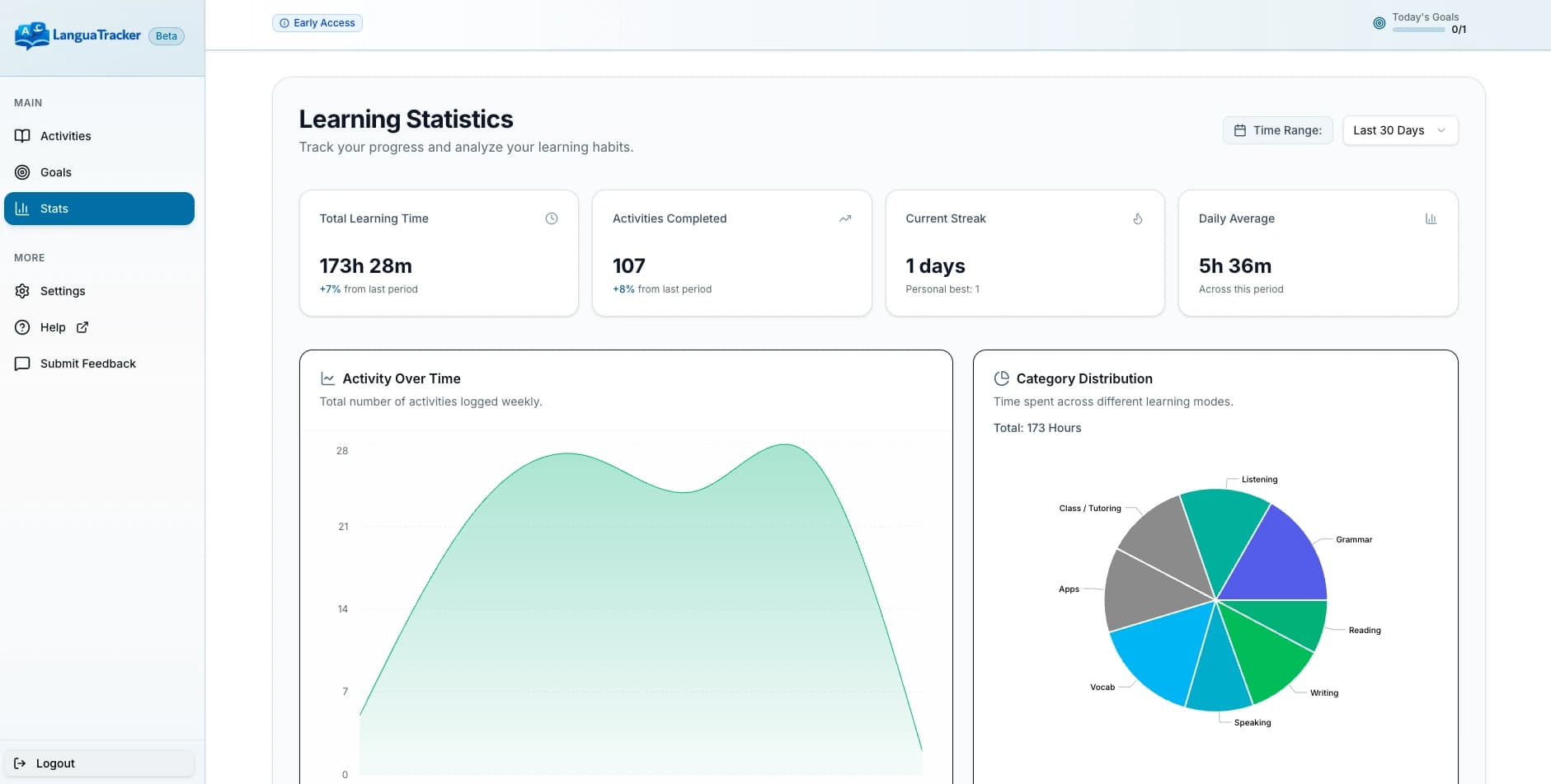
When progress feels invisible, the solution is simple in principle: make it visible.
LanguaTracker
was built for exactly this. It lets you log listening, reading, speaking, and
writing sessions across all your resources, review weekly and monthly summaries
to see cumulative growth, identify imbalances between your input and output
skills, and stay consistent during plateaus by seeing proof (not just hope) that
you're still moving forward.
It takes seconds to log a session. Over months, those logs become undeniable evidence that progress is happening, even when it doesn't feel that way.
Language learning isn't linear, but it is trackable. And when you track it, whether it's with LanguaTracker or some other method, you realize you're further along than you think.