What's New in LanguaTracker: Fluency Forecast, Daily Reminders, and Suggested Goals
Three new features just shipped to LanguaTracker. Each one addresses something real: the uncertainty of not knowing where you stand, the drift that comes from inconsistency, and the friction of figuring out what to work toward. Here's what's new.
Fluency Forecast
Every serious language learner has been told the same thing: it takes years. Maybe three. Maybe five. It depends. There's rarely a concrete number, and there's almost never a date.
That vagueness isn't helpful. It makes the journey feel infinite, which makes it easy to lose momentum, especially in the long middle stretch between beginner and fluent.
Fluency Forecast changes that. It's LanguaTracker's core predictive feature built on our custom language forecasting model: MosaicParrot. It gives you a real, data-driven window into your path to fluency.
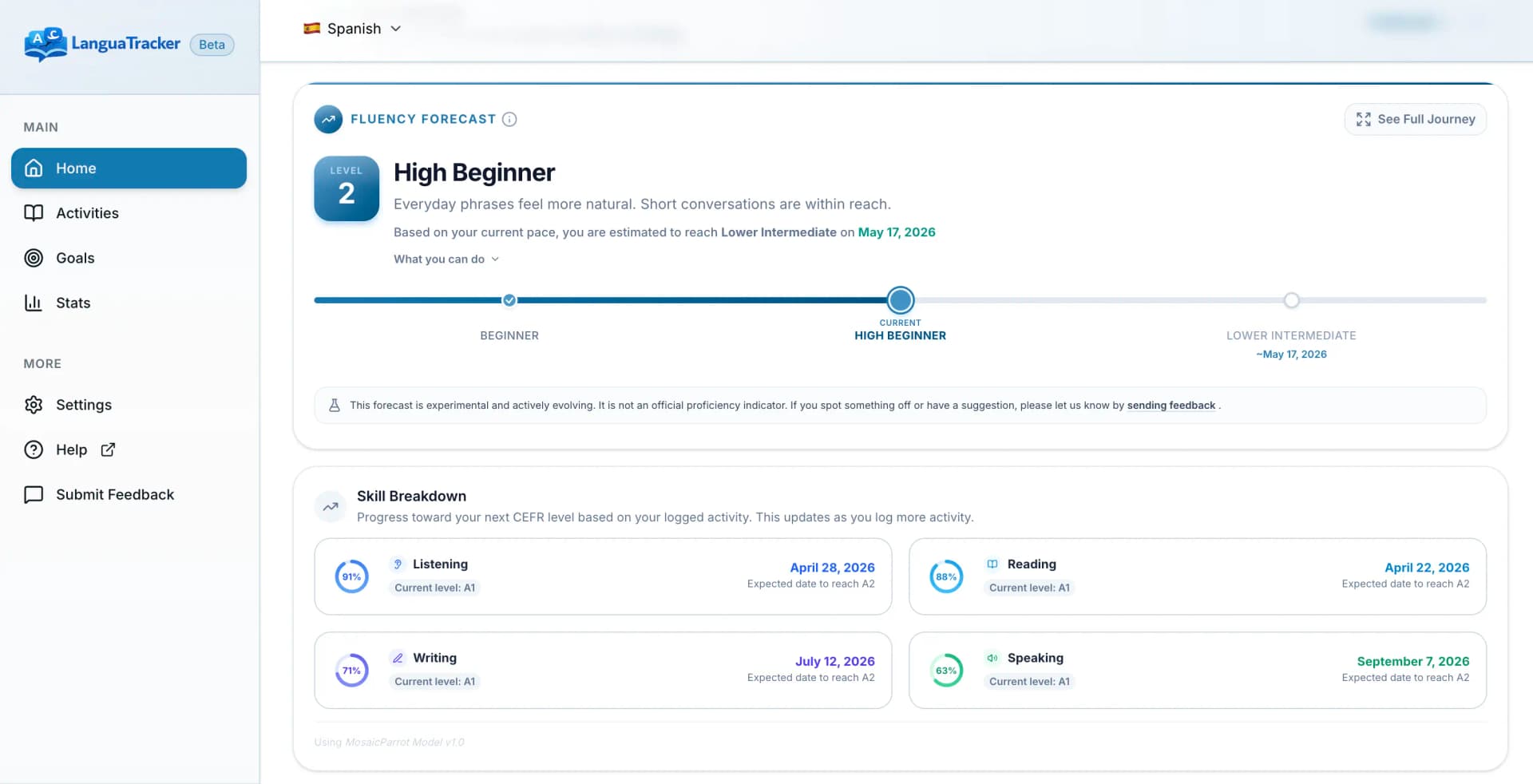
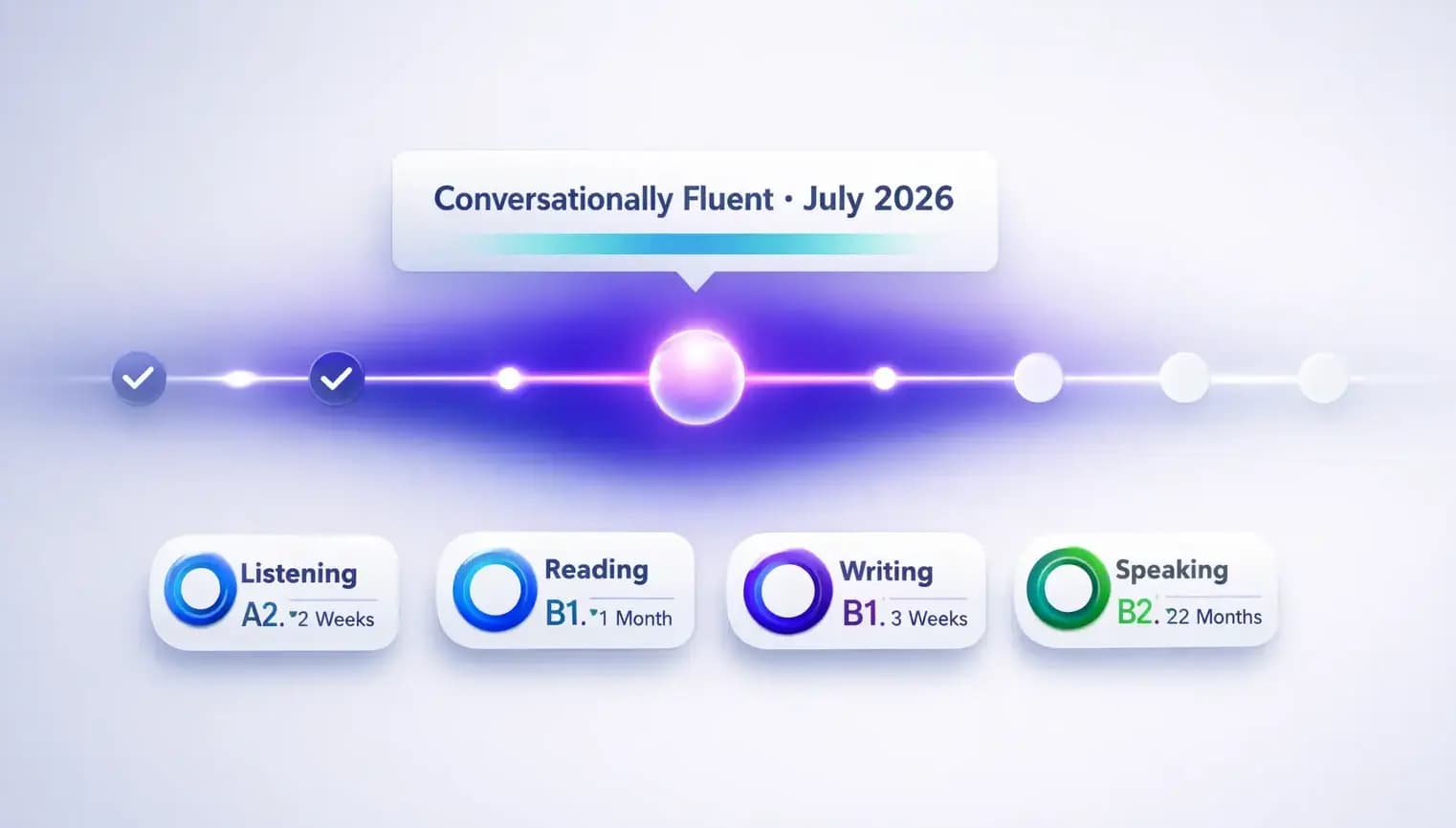
Your journey is mapped across eight stages: Beginner → High Beginner → Lower Intermediate → Intermediate → Upper Intermediate → Conversationally Fluent → Full Proficiency → Near Native. To view it, navigate to the home section in the app. It shows your current stage and displays a specific estimated arrival date for the next one. Something like: "Based on your current pace, you are estimated to reach Conversationally Fluent on July 12, 2027."
Each stage comes with practical detail such as what you can do at that level, a milestone message, a curated study focus tip. You can expand the full journey to see all eight stages at once.
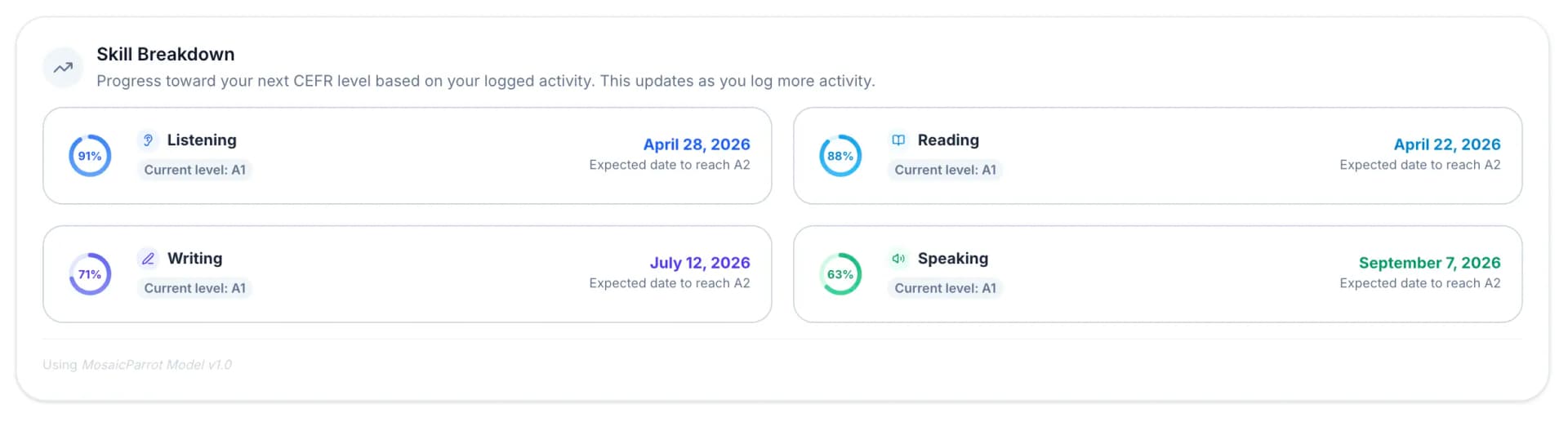
Below the journey card, a Skill Breakdown section shows progress rings for each of your four skills individually: Listening, Reading, Writing, and Speaking, each with its current CEFR level and a specific predicted date to reach the next one. So you're not just watching a single aggregate number move. You can see that your Reading is six months ahead of your Speaking, or that your Listening is about to cross into B2. Of course if each of your levels are progressing at a different speed, that can totally be intentional.
The forecast is personalized and updates as you log more activity. The model accounts for how your four skills interact and reinforce each other, grounded in language acquisition research. Logging a reading-heavy week affects your expected writing and listening trajectory, not just reading. And rather than giving you a single rigid date, it shows a confidence range so you see a realistic band.
If you haven't logged enough activity yet, the forecast will prompt you to do so before it unlocks. The model needs enough data to be meaningful, and showing you a guess isn't the goal.
Key Takeaway
Fluency Forecast gives you a specific predicted date to reach each fluency stage and CEFR level broken down by skill, updated as you log, and built on a confidence range rather than a single arbitrary number.
Daily Reminders
The biggest enemy of language learning progress isn't a bad study session. It's the session that never happens because you forgot, got distracted, or just didn't have logging on your mind that day.
Daily Reminders provide daily email reminders to log your progress. It can be configure in the Settings section. You pick a time of day and you get one email reminder to log your language learning progress. It doesn't nag you. It doesn't send three notifications. One email, at the time you choose. The reminder is smart enough to know when you've already logged progress for the current day, so if you've already logged, then you won't get the reminder for that day.
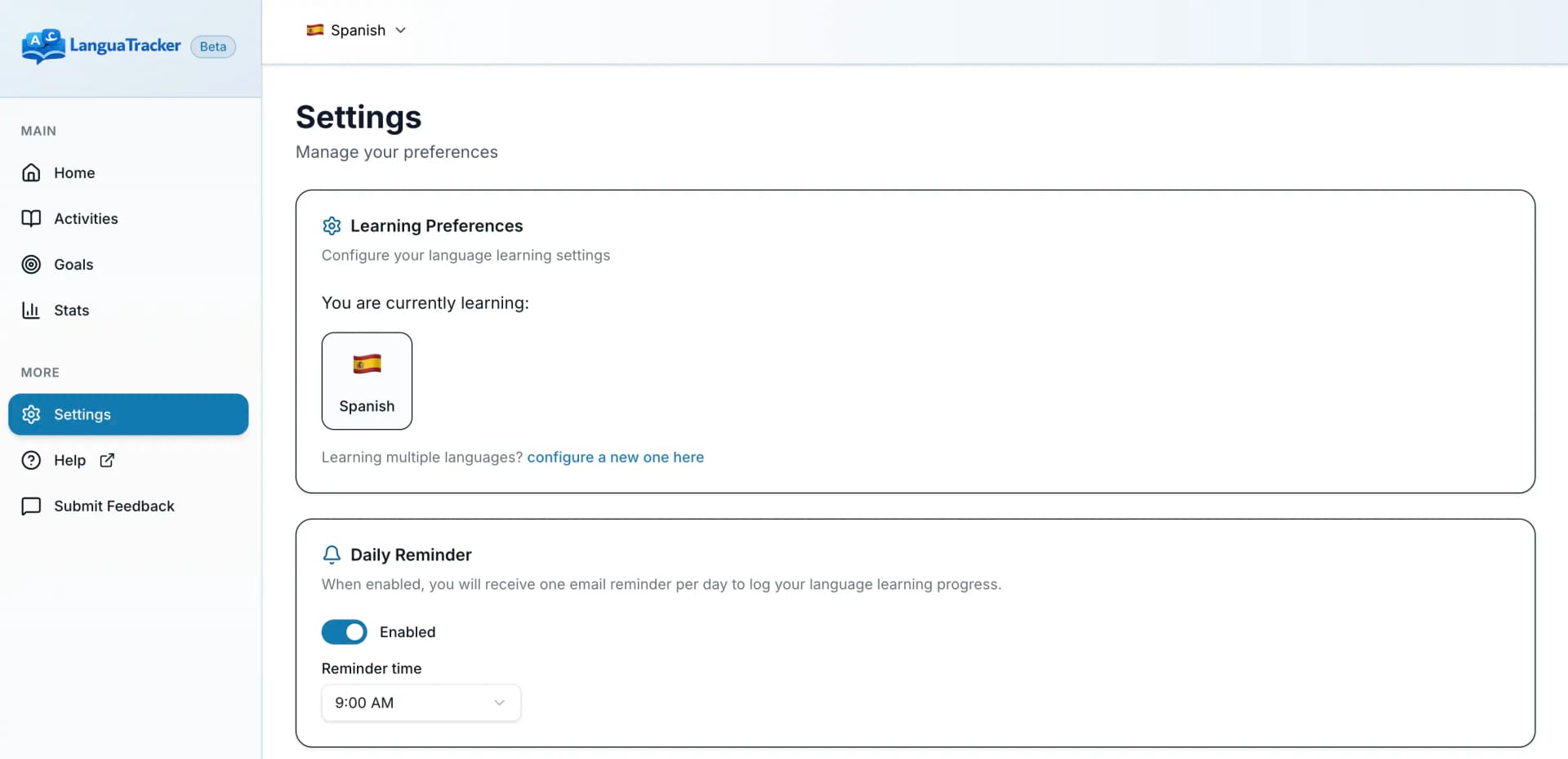
Consistency compounds. A reminder that shows up at the same time every day becomes part of your routine, and routines survive the days when motivation doesn't.
Suggested Goals
Setting your own goals from scratch requires knowing what's realistic for your level and pace. Most learners either set goals that are too ambitious and abandon them, or set goals that are too vague and never act on them.
Suggested Goals closes that gap. It analyzes your activity history and current study pace — specifically how many minutes per day you're averaging — and surfaces a set of goals that actually fit your life. Suggestions are organized into tiers based on how much you currently study, so a learner putting in 15-30 minutes per day sees different recommendations than someone logging 60+ minutes daily.
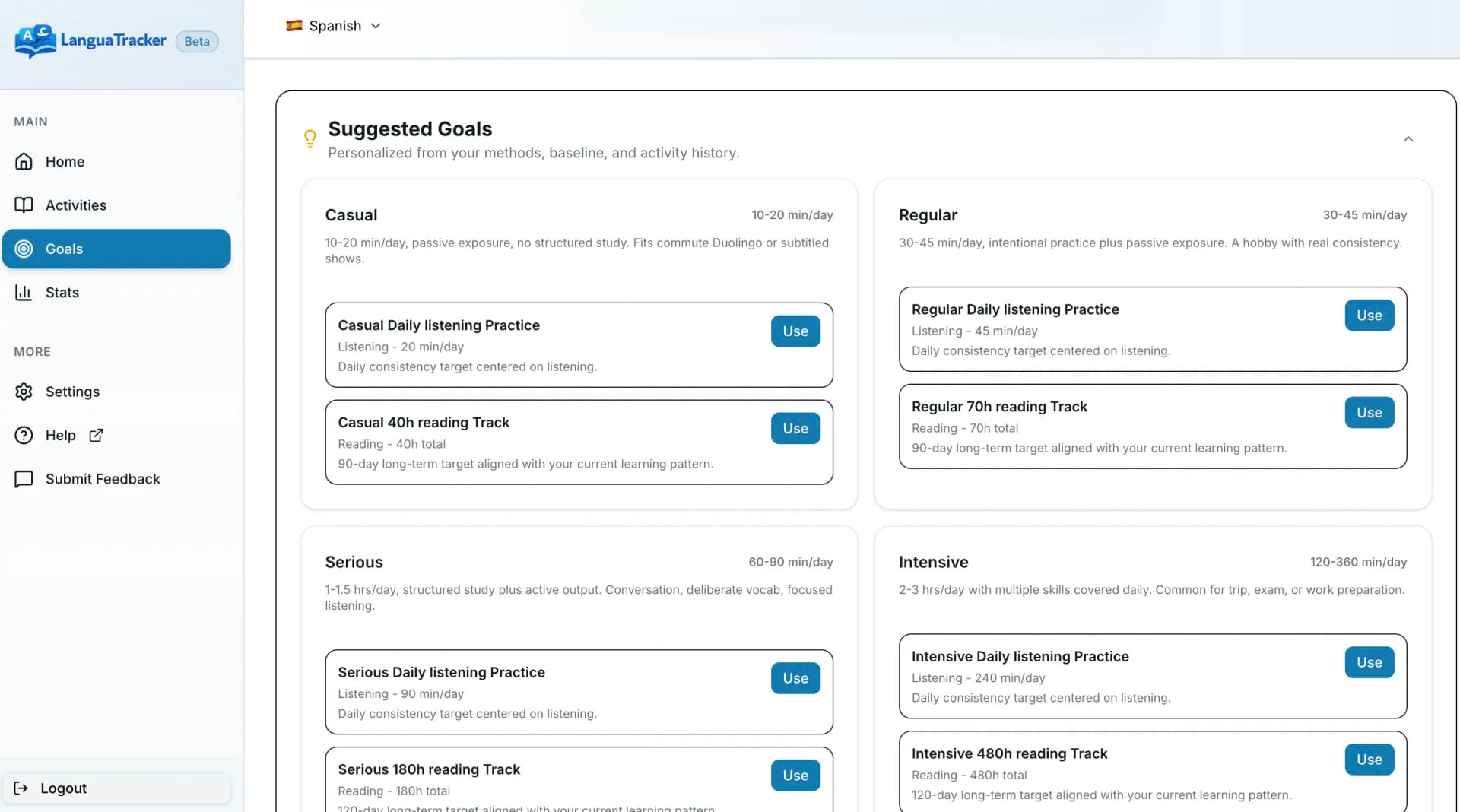
Each suggestion has a name, a category (Listening, Reading, Writing, Speaking), a target value, and a short description of what you'd be committing to. Clicking "Use" adds it to your profile instantly. Goals you've already added are marked and disabled.
All three features are live now. If you have thoughts after trying them, feedback is open — the way these features evolve is based on what's actually useful to you.
See Your Fluency Forecast
Log your activity, unlock your forecast, and find out when you're expected to reach your next fluency stage.
Open LanguaTracker