
Consistency Beats Motivation in Language Learning

Learning a language often begins with motivation.
You buy a course. Download three different apps. Watch YouTube videos about people who became fluent in six months. You may even study every single day for two straight weeks.
It feels exciting. Full of possibility. You can already imagine yourself having conversations in your target language.
Then real life shows up.
Work gets busy, then your energy drops. You skip a day, then another. Suddenly, that daily habit has completely disappeared, and motivation alone is not enough to restart it.
This is where most learners misunderstand what actually creates success.
Motivation helps you start. Consistency is what gets you fluent.
Key Takeaway
Successful language learners do not rely on feeling motivated every day. They build small, repeatable habits that continue even when motivation fades.
Why Motivation Is Unreliable (Even Though It Feels Powerful)
Motivation feels like the most important ingredient in language learning because it creates those satisfying bursts of action.
The problem? Motivation naturally fluctuates. It is tied to your emotional state, energy levels, stress, and dozens of other factors you cannot control.
Psychological research shows that behavior driven primarily by emotion tends to be inconsistent over time. A study by Lally et al. (2010) on habit formation found that automatic behaviors develop through repetition, not through motivation or willpower alone.
Think about brushing your teeth. You do not wait until you feel motivated to brush. You just do it because it is part of your routine. That is the power of consistency over motivation.
In language learning, your progress depends far less on intense, inspired sessions and much more on simply showing up regularly.
You do not need perfect study days. You need frequent ones.
The Consistency Advantage: What the Research Actually Shows
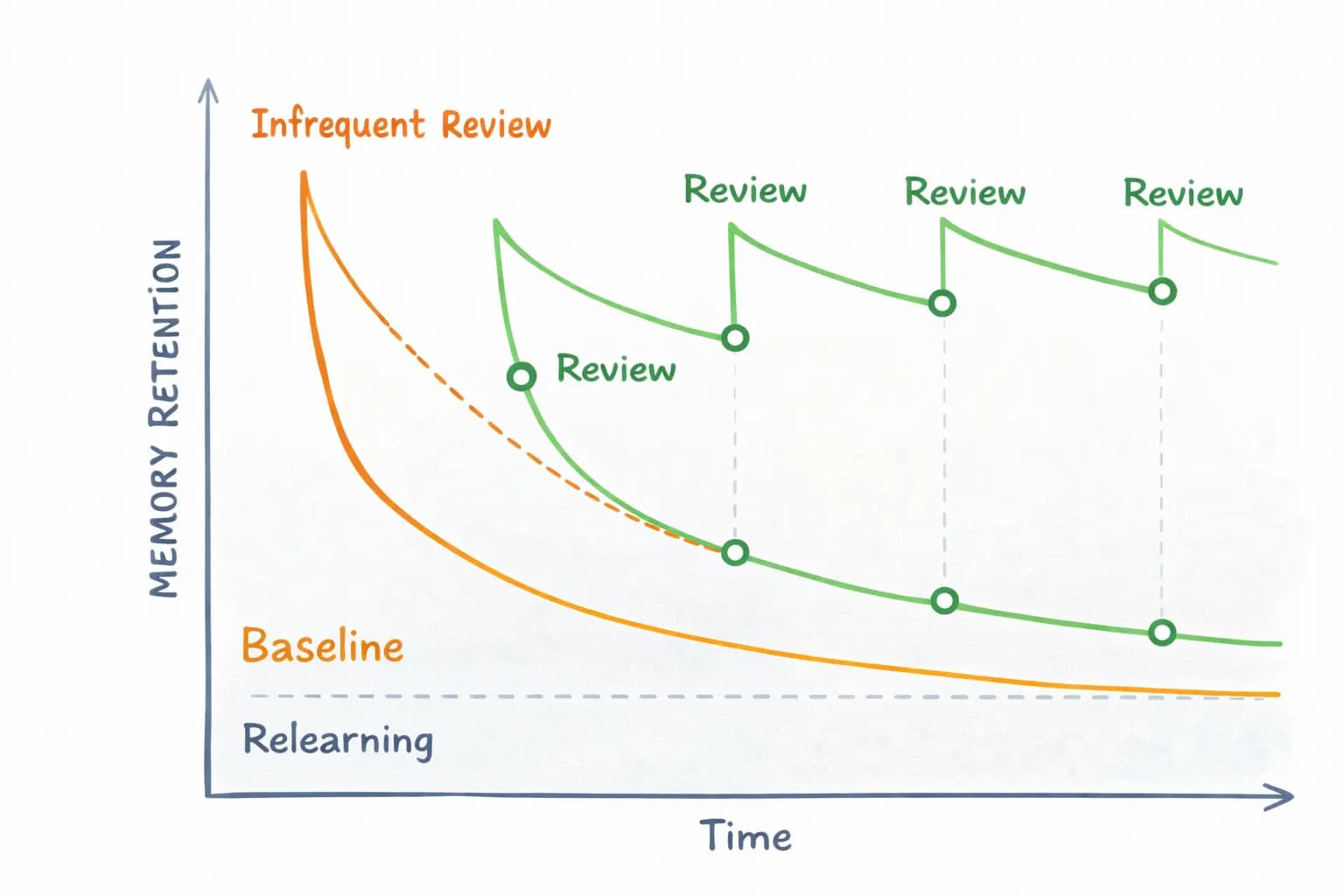
Here is something that surprises most learners: the pattern of your study matters more than the total hours.
Research by Cepeda et al. (2006) demonstrated that spaced practice significantly improves long-term retention compared to irregular, cramming-style study patterns. In practical terms: studying 20 minutes daily beats studying 3 hours once a week.
Your brain needs regular activation to build and strengthen neural pathways. When you study daily, even briefly, you keep those pathways active. When you study in long, infrequent bursts, your brain has to rebuild connections each time.
Regular exposure strengthens memory. Gaps force your brain to relearn material repeatedly. Consistency reduces forgetting.
This is not about working harder. It is about working more regularly.
Motivation vs Consistency: How They Actually Play Out
Most learners do not realize they are following a motivation-based approach until it stops working. Here is what the difference looks like in practice:
Motivation vs Consistency: How They Actually Play Out
Most learners do not realize they are following a motivation-based approach until it stops working.
| Approach | Motivation-Based Learning | Consistency-Based Learning |
|---|---|---|
| Study pattern | Intense bursts, long gaps | Small daily sessions |
| Emotional dependence | High (requires feeling "ready") | Low (happens regardless of mood) |
| Retention | Unstable, lots of reviews needed | Strong compounds over time |
| Burnout risk | High (unsustainable intensity) | Low (manageable effort) |
| Long-term progress | Irregular, unpredictable | Steady, predictable |
| Guilt when skipping | High | Lower (easier to restart) |
Notice the pattern? Motivation creates spikes of activity followed by valleys of nothing. Consistency creates accumulation.
And accumulation is what language learning is fundamentally about. You cannot cram fluency. You have to build it brick by brick, day by day.
What Consistency Actually Looks Like (It's Smaller Than You Think)
When people hear "be consistent," they often imagine studying for an hour every single day without fail.
That is not what consistency means.
Consistency means removing friction so learning happens even on your worst days.
Here is what real consistency looks like:
- Listening to a 10-minute podcast during your commute
- Reading one article before bed
- Speaking for five minutes with a tutor
- Reviewing 10 vocabulary words during lunch
- Watching one YouTube video while eating breakfast
These are small, specific, and tied to existing parts of your day. Progress feels subtle day to day. But over months, those minutes compound into hundreds of hours of exposure.
Small daily actions are not impressive. But they are effective.
Why Learners Quit (And How to Prevent It)
Most learners build their entire system around ideal conditions. They plan to study when they feel focused, energized, and inspired.
But language learning spans months or years. Motivation will inevitably dip. Multiple times.
Without a simple routine, learners interpret low motivation as personal failure instead of recognizing it as a normal phase.
Like we mentioned previously, language learning progress is not linear.
When progress slows and motivation fades at the same time, quitting feels logical.
Consistency prevents that cycle. When you have a minimal daily habit, you keep showing up even when motivation is low. And when motivation returns, you have not lost ground.
The Hidden Power of Tracking Your Habits
Here is something that most learners do not realize: one of the strongest predictors of consistency is simply monitoring what you are doing.
Harkin et al. (2016)
found that tracking progress significantly increases goal achievement because it reinforces behavioral awareness. The act of logging creates psychological accountability.
When you track your language activities, two powerful things happen:
- You become more aware of your actual habits (not just what you think you are doing)
- You are significantly more likely to continue those habits
Consistency Without Tracking vs With Tracking
How visibility changes your relationship with consistency
| Scenario | Without Tracking | With Tracking |
|---|---|---|
| Missed sessions | Easy to ignore or forget | Visible immediately |
| Progress perception | Based on feelings | Based on actual data |
| Habit strength | Fragile, dependent on mood | Reinforced by evidence |
| Motivation dips | Often leads to quitting | Easier to recover from |
| Long-term awareness | Low (memory is unreliable) | High (data tells the truth) |
Tracking turns consistency from an abstract idea into something tangible you can see.
Without tracking, you operate on feelings. I think I studied a lot this week. It feels like I am not making progress.
With tracking, you operate on facts. I logged 6 out of 7 days this week. I've hit my minimum for 23 days straight.
Facts are much more motivating than feelings, especially during plateaus.
How to Build a Consistent Language Learning Habit
You do not need a complicated plan. In fact, complicated plans usually fail because they require too much motivation to maintain.
Start with these three simple rules:
1. Lower Your Daily Minimum to Something Ridiculously Small
Make your baseline so small it feels almost impossible to skip.
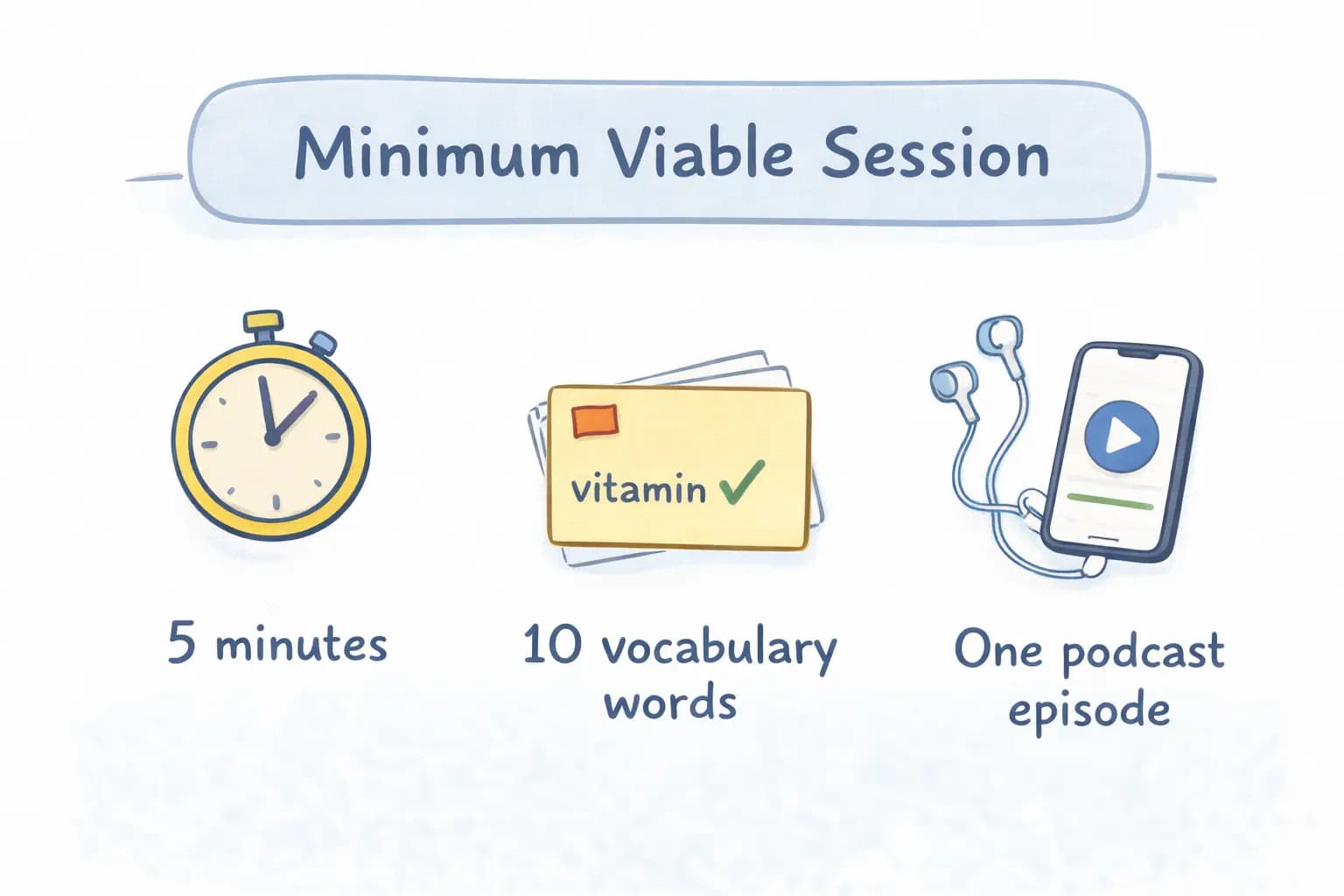
Five minutes counts. One podcast episode counts. Ten vocabulary words count.
Most learners set their minimum too high. They think, "I will study for 30 minutes every day." Then life gets busy, they only have 15 minutes, and they skip entirely because "it is not enough."
You can always do more when you have time and energy. But the minimum keeps the habit alive during chaos.
2. Attach Language Learning to Existing Routines
Do not rely on finding "extra time" in your day. That time does not exist.
Instead, pair language exposure with habits you already have:
- Morning coffee → Listen to a podcast in your target language
- Commute time → Audio lessons or music
- Evening wind-down → Read one article before bed
- Lunch break → Five minutes of speaking practice
- Workout → Listen to comprehensible input
When you attach new habits to existing ones, you remove the decision fatigue of "when should I study?" The answer becomes automatic.
3. Track Completion, Not Perfection
The goal is not to have amazing study sessions every day. The goal is continuity.
Did you show up? Yes or no. That is the only question that matters for building consistency.
Some days you will study for an hour and feel great. On other days, you will barely hit your five-minute minimum and feel like it was not enough.
Both days count equally for building the habit.
Over time, this approach does something powerful: it builds identity. You stop being "someone trying to learn a language" and become "someone who practices daily."
That identity shift is what makes consistency effortless eventually.
FAQ
Where LanguaTracker Fits In
Consistency becomes dramatically easier when your effort is visible.
Without tracking, consistency is abstract. You think you are showing up regularly, but you are not sure. Doubt creeps in. Motivation has to fill the gap.
With tracking, consistency becomes concrete. You know you are showing up because you can see the proof.
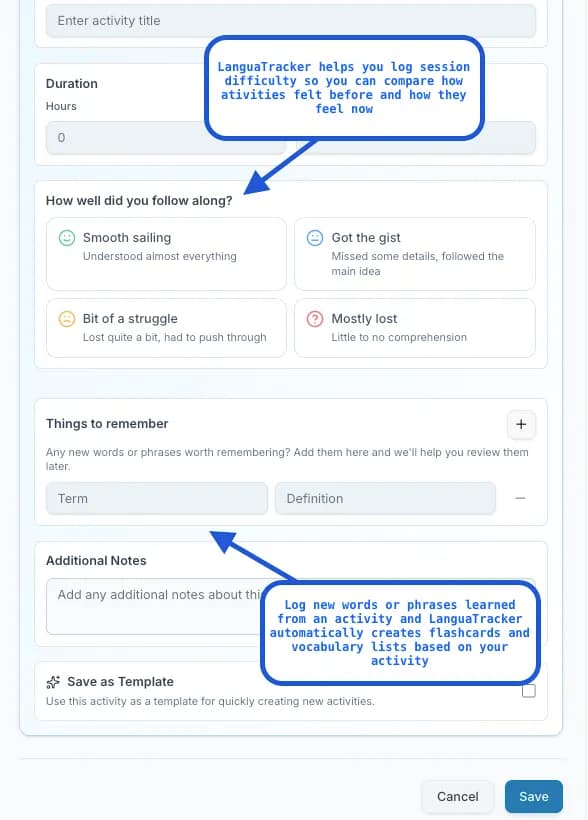
LanguaTracker is the support system built around this. You log your study activity in seconds — categorized by activity type, not just totaled by time. That means you can see not just that you showed up, but whether the activities you're consistently doing are actually moving the right skills: comprehension, vocabulary, speaking fluency, reading speed.
Completion data and goal progress keep the consistency habit intact. Skill-specific signals tell you whether that consistency is pointed in the right direction. Both matter, and measuring one without the other only gets you halfway there.
You can also track how difficult an activity felt or new words/phrases/concepts you learned, and LanguaTracker will use this to provide insights about your strengths and areas to work on.
You stop wondering if you're being consistent. You know. And you know whether it's working.
Language learning success is rarely about dramatic effort or intense motivation.
It is about showing up again tomorrow.
And the day after that. And the day after that.
Small daily actions compound into fluency over time. Consistency is not flashy. But it works.
Start Building Consistent Language Habits Today
Turn small daily actions into long-term fluency. Track your study activity in seconds and see how consistency compounds over time.
Start Tracking